Pages

Showing posts with label היתנתקות. Show all posts

Wednesday, September 19, 2007

לעולם לא עוד / Never Again / Nunca más

בס״ד


http://video.google.com/googleplayer.swf?docId=3076127704169780877&hl=en
Produced by the World Committee for Saving the Jewish People and the Land of Israel (המטה העולמי להצלת העם והארץ), this critical documentary exposes the false promises of the Israeli government to the Jewish residents of Gush Katif to get them to leave their homes.

Producido por el Comité Internacional para Salvar al Pueblo Judío y a la Tierra de Israel (המטה העולמי להצלת העם והארץ), este documental crítico expone las falsas promesas de las que se valió el gobierno israelí para convencer a los residentes judíos de Gush Katif a abandonar sus hogares.
The tragedy of the expulsion of the Gush Katif Jewish residents and the destruction of their communities reaches many layers of depth, as shown in the film.

La tragedia de la expulsión de los residentes judíos de Gush Katif y la destrucción de sus comunidades alcanza muchos niveles de profundidad, como se muestra en el filme.
The destroyed communities of Gush Katif, in the Gaza Strip, are today under the control of Hamas. No longer under Israeli control, the region has become a nest of extremist Islamic fundamentalism. Rockets are still being shot against Jewish communities within the Green Line, Israel’s border before the 1967 Six Days War.

Las destruidas comunidades de Gush Katif, en la Franja de Gaza, están hoy bajo el control de Hamás. No estando más bajo el control de Israel, la región se ha tornado en un nido del fundamentalismo islámico extremista. Aun ahora se sigue disparando cohetes contra comunidades judías de dentro de la Línea Verde, la frontera israelí de antes de la Guerra de los Seis Días de 1967.

Yet, not having learned the lessons of history and its upheavals, the Israeli government is yet again about to proceed with the destruction of the Jewish communities of Judea and Samaria, the liberated Jewish territories of the West Bank.


Sin embargo, no habiendo aprendido las exasperantes lecciones de la historia, el gobierno de Israel está, una vez más, a punto de proceder con la destrucción de comunidades judías en Judea y Samaria, los territorios judíos liberados en Cisjordania.

May the lessons from the events depicted in this film reach us all in time to turn around the current debacle, and somehow correct the horrors of a government turn against its very own citizens for the sake of enemy, foreign interests. May these horrors be repeated NEVER AGAIN!


Que las lecciones de los eventos presentados en este filme nos alcancen a tiempo para poder voltear el curso de la debacle presente, y de alguna manera podamos corregir los horrores de un gobierno tornado contra sus propios ciudadanos por la causa de intereses enemigos y extranjeros. ¡Que estos horrores no se vuelvan a repetir NUNCA JAMÁS!

Thursday, May 03, 2007

Thursday, January 04, 2007

Llover sobre mojado / Beating a Dead Horse

בס״ד

Lo he dicho tantas veces, que bien cabría preguntarse para qué insistir. La evidencia es abrumadora, y sería difícil argumentar que quienes todavía se enfrascan en negarla o tergiversarla tengan la esperanza de rectificarse: La rendición (o “retirada unilateral”, en el newspeak demofrénico tan de moda en entre políticos israelíes) del territorio de las comunidades de Gush Katif (Franja de Gaza) y de Tzfón HaShomrón (Samaria del Norte) fue uno de los peores errores intencionales de la historia moderna de Israel.

I have said it so many times that it is fit to ask why to insist any further. The evidence is overwhelming and it would be difficult to argue that those who today still persist denying or twisting it have any hopes of straightening themselves out: The surrender (or unilateral withdrawal,” in the demophrenic newspeak so fashionable among Israeli politicians) of the territory of Gush Katif (Gaza Strip) and Tzfon HaShomron (Northern Samaria) was one of the worst intentional mistakes of Israel's modern history.


¿Por qué no cansarse de decirlo, y dejar que los errores del ayer queden en el mero ayer? Porque a diario se nos recuerda el asunto. Porque vivimos de día en día, de hora en hora, las nefastas consecuencias. Porque la agravante situación llora a gritos pidiendo el tikún, el complicado procedo de rectificación del error. Porque el régimen de Kadima, culpable por la debacle, sigue por el camino del error, trayendo una tragedia tras otra sobre el pueblo, la tierra y el estado de Israel.

Why shouldn't I just get tired of repeating it, and let yesterday's mistakes stay right there, in the past? Because everyday we're reminded of the issue. Because we live, day to day, hour to hour, its harmful consequences. Because the ever-worsening situation cries out loud asking for the tikun, the complicated process of error rectification. Because the Kadima regime, the guilty party for the current fiasco, is still going on the same wrong way, bringing tragedy after tragedy to the people, the land, and the state of Israel.


¿Pero qué diferencia pueden hacer ahora mis palabras? No lo se. Lo que si, el lenguaje visual puede ser útil.

But what difference could my words make? I don't know. Certainly, visual language could be useful.


He acá un par de imágenes que muestran claramente el resultado de la rendición de Gush Katif.

Here are a couple of images that clearly show the result of the surrender of Gush Katif.


Antes de la rendición, los famosos invernaderos del Gush eran la base de una industria prolífica. Siempre verdes, los invernaderos producían verduras libres de insectos sin necesidad de usar insecticidas:

Before the surrender, the famous green houses of the Gush were the foundation of a prolific industry. Always green, they produced insect-free vegetables without the use of insecticides:


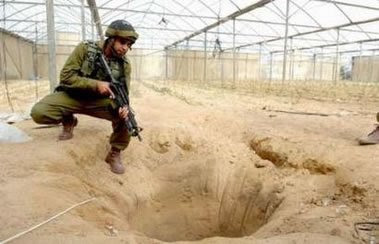
Después de la rendición, el ejército de Israel tuvo que realizar operaciones de vuelta en el territorio abandonado, desde donde los ataques con cohetes no dejan de llegar. Se dice que los árabes construyeron túneles para traer armas y piezas para ensamblar cohetes. Pero... ¿Cómo camuflar el hoyo de salida de tremendos túneles?

After the surrender, the Israeli Army had to carry out a series of operations back on the abandoned territory, since the rocket attacks have not stopped. It is said that the Arabs have build tunnels in order to bring weapons and pieces to put together their rockets. But... how could they hide the enormous exit holes?


<

(Nótese el árido entorno, como ya dije en el post anterior)

(Notice the arid surroundings, which I mentioned in the previous post)

Recomiendo también tres videos preparados con el motivo de la conmemoración del primer año de la redición:

I recommend also three videos made in commemoration of the first year anniversary of the surrender: